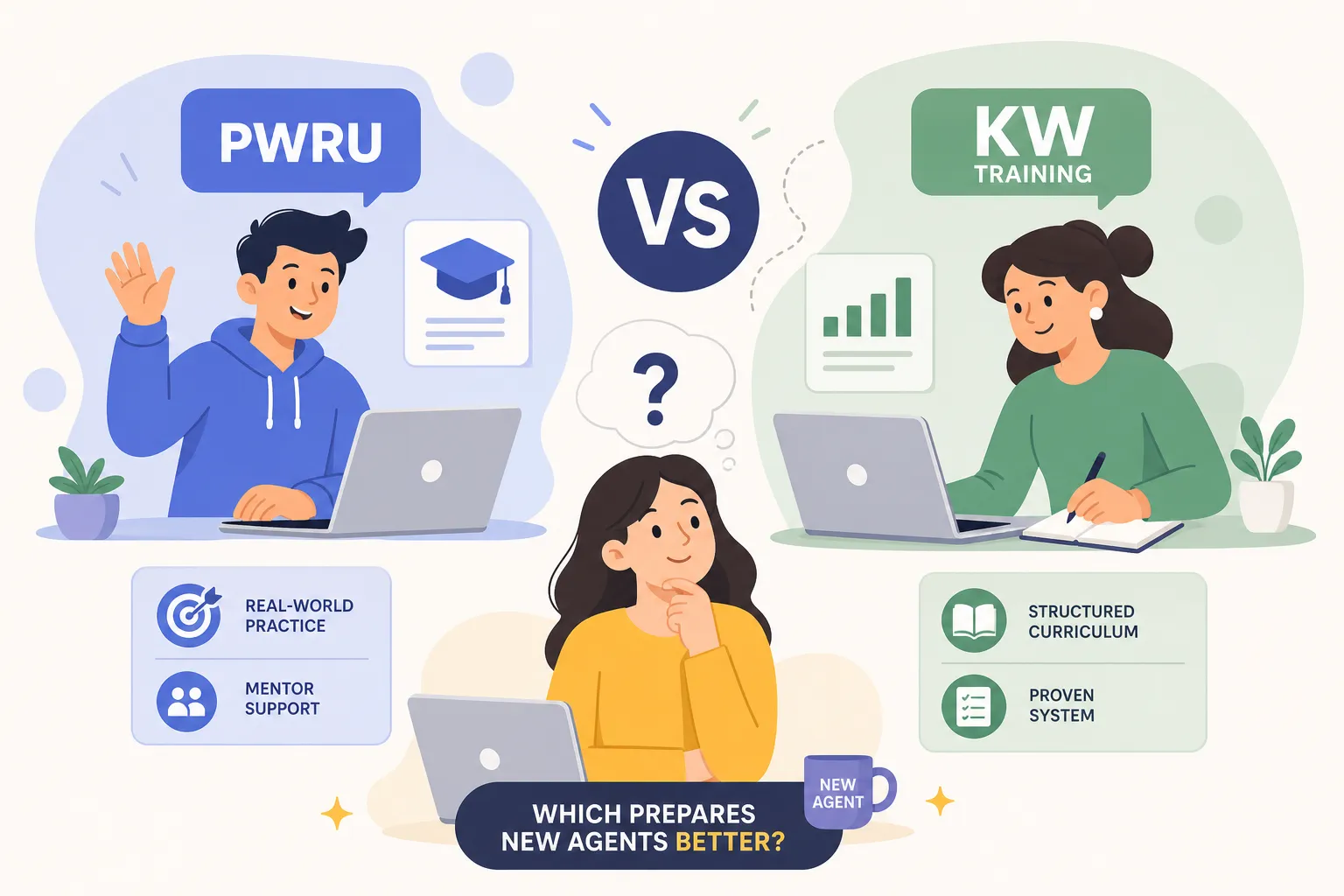
If you’re comparing PWRU vs. Keller Williams training before committing to either program, you’re asking the right question. Full disclosure: we built PWRU University at Power Unit Coaching, so this comparison isn’t coming from a neutral third party. What it is coming from is eight years of watching agents go through both types of programs and knowing exactly where each one delivers and where each one falls short. That’s worth more than a neutral opinion from someone who hasn’t built anything.
The core tension in the PWRU vs. Keller Williams training debate isn’t about which program has more content. KWU is one of the most resource-rich training libraries in the industry. The real question is what “prepared” actually means for a new agent. Does it mean access to 1,000+ hours of on-demand content? Or does it mean knowing exactly what to do tomorrow morning? Those are two different definitions, and the program you choose should match the one that fits your situation.
What Each Program Actually Teaches
KWU’s curriculum is genuinely broad. The Ignite program runs about one month, covers 18 power sessions, and is specifically designed to get new agents into production quickly. Beyond Ignite, KW Connect houses over 1,000 hours of on-demand video, playbooks, live sessions, and conversation frameworks. Programs like BOLD (advanced sales tactics and mindset), SHIFT, and MREA add depth for agents further along in their careers. The breadth is real and the library is substantial.
The gap isn’t content volume, it’s sequence. An agent who logs into KW Connect faces a massive library with no built-in directive for what to do first, second, or tomorrow. Local market centers add daily classes and book clubs, but the quality of those varies enormously by location. Some offices run tight, structured onboarding. Others leave new agents largely on their own after Ignite wraps up.
How PWRU University Structures the Learning Path
PWRU University is organized differently. The curriculum runs on the PULSE Method, a 6-pillar framework that sequences exactly what an agent learns and in what order, according to Power Unit Coaching’s published program documentation. There’s no library to explore. The path is defined: sphere of influence strategy, lead conversion scripts, pipeline management, and daily production habits, sequenced toward a measurable outcome. The design philosophy is prescriptive rather than exploratory. Most agents don’t figure out why that matters until they’re three months in and still spinning.
PWRU vs. Keller Williams Training: Daily Execution Tools
KW Command is a capable CRM. It handles pipeline tracking, lead management, and contact organization inside the KW ecosystem. In 2026, Command also includes KWIQ, an AI chat assistant for answering system questions, and an AI Contact Timeline Summary that helps agents prioritize follow-ups by condensing a contact’s interaction history. These are useful features. (Recent updates even added generative AI copywriting for ads.) The structural limitation: Command is a tool the agent manages. It doesn’t generate a morning action plan based on the agent’s income goal.
PULSEIntel PRO, the AI tool inside PWRU University, works differently. An agent inputs their income goal, and the system generates a personalized daily action plan, how many contacts to make, which leads to follow up on, and which tasks to prioritize. Per Power Unit Coaching’s platform documentation, it consolidates functionality from multiple standalone tools into one system and eliminates the daily “what should I work on?” decision that quietly kills most agents’ consistency. That’s the meaningful operational difference between a dashboard you manage and a system that manages your day.
PWRU vs. Keller Williams Training: Coaching and Accountability
KW’s mentorship model is locally driven. Many market centers assign new agents a Productivity Coach, typically an experienced agent within the office who provides accountability and guidance through early transactions. In theory, this 1:1 pairing is a strong model. In practice, the quality varies significantly by market center. Some offices deliver daily accountability and genuine mentorship. Others leave new agents to figure things out independently after Ignite ends. That inconsistency isn’t a criticism of the model, it’s an honest description of how a franchise with thousands of locations operates.
How PWRU Builds Accountability Into the Platform
PWRU University builds accountability into the platform architecture rather than layering it on as an add-on. PULSEIntel PRO creates a natural daily check-in loop because the morning plan exists and the agent either executes it or doesn’t. For brokerage owners who deploy the BPS (Broker Platform Solution), an admin dashboard and leaderboard show real-time agent activity, completion rates, and production data, per Power Unit Coaching’s product documentation. AI role-play simulations let agents practice scripts before live conversations. That removes one of the biggest reasons new agents hesitate to pick up the phone.
The consistency of the coaching experience doesn’t depend on a single market center’s talent pool. That’s the structural advantage of platform-driven accountability over locally managed mentorship.
The Real Cost of Each Program
KW’s cost structure is worth understanding before you focus on the headline split. The standard commission arrangement commonly runs in the range of 64/36 to 70/30 before cap, depending on the market center. Beyond the split, the full structure includes:
- Annual market center cap: Varies by location, roughly $15,000 in lower-cost markets to $36,000 or more in premium markets
- Royalty fee: 6% per transaction, capped at approximately $3,000 per year paid to KW International
- Monthly office fees: Desk, technology, and E&O insurance typically add $60 to $350+ per month depending on the office
- Program upgrades: Core KWU training is largely included at base level, but programs like BOLD run approximately $800
The 70/30 split sounds straightforward. The total cost structure is more layered once you account for all the pieces.
PWRU University operates on a different model. It’s a subscription-based program, separate from whatever brokerage the agent is affiliated with. Per Power Unit Coaching’s published pricing, the program fee travels with the agent regardless of brokerage. Brokers who deploy BPS pay separately at the brokerage level rather than per agent. When evaluating cost, the more useful question isn’t how many training hours you’re getting, it’s whether the system produces consistent closings. In the authors’ view, that’s the only ROI metric that truly matters.
Agent Outcomes: What Each Program Actually Produces
KWU’s Ignite program is designed to accelerate early production, with the goal of getting new agents into their first transaction within roughly the first month. More broadly, new agents at KW typically close their first deal somewhere between three and six months in, with some taking closer to a year depending on market conditions, self-discipline, and the quality of the local market center. Published data on year-one transaction counts for KW agents isn’t consistently available, and outcomes vary too much across thousands of offices to generalize reliably. What is consistent across agent feedback is that training quality, mentorship support, and production outcomes are heavily dependent on which market center the agent lands in.
PWRU University is built around a specific outcome benchmark: 3 or more closings per month. The PULSE Method and PULSEIntel PRO are engineered toward that target, not toward content completion hours. Power Unit Coaching cites its U.S.-based agent case studies as the foundation for that benchmark, those materials are available directly through the program. KWU measures success by access to resources and initial launch activity. PWRU measures success by whether the agent is producing at a defined, consistent rate. Those are fundamentally different definitions of a win.
Which Training Path Actually Fits Your Situation
KW training is a strong fit for agents who want a large, well-established brand and are genuinely self-directed learners. If you land in a market center with experienced Productivity Coaches and active daily training sessions, KW can be a solid environment to grow in. KW Connect’s library is genuinely valuable for agents who will take the time to navigate it with discipline and purpose.
PWRU University is a better fit for agents who need structure over volume. If you’re starting from zero, stuck under two closings per month, or finishing training sessions and still not knowing what to do the next morning, the PULSE Method and daily action plans from PULSEIntel PRO solve a different problem than a content library does. PWRU is also brokerage-agnostic. You can use the training and tools at any brokerage without being locked into a specific franchise to access it.
Before committing to either program, run through these questions:
- How does this program tell me what to do tomorrow morning?
- What measurable production outcome is the training designed to deliver?
- Who holds me accountable after month one when the initial energy fades?
If you’re evaluating other providers, see our Power Unit Coaching vs Buffini | Real Estate Training Comparison.
The answers will tell you more than any feature comparison.
The Best Training Is the One That Tells You What to Do Next
When evaluating PWRU vs. Keller Williams training, give credit where it’s due: KWU is a legitimate, well-resourced system. It works for agents who are self-directed, who land in a strong market center, and who can navigate a large library without losing momentum. That’s a real group of people.
But most new agents don’t know what to do each morning. They finish a training session and still feel stuck. They have access to content but no execution system to translate that content into daily action. That’s the gap Power Unit Coaching built PWRU University to fill, not more material to consume, but a daily plan to execute, tied to a production outcome the agent can actually measure.
If you want structure over volume and a system that generates a morning plan instead of waiting for you to build one, explore PWRU University at Power Unit Coaching. The best training program isn’t the one with the most content. It’s the one that tells you exactly what to do next.
