
If you’re asking what is the best system for closing more real estate deals consistently, the answer isn’t a better script or a hotter lead source. Most agents don’t have a closing system. They have a closing hope. They prospect hard for a few weeks, land a couple of deals, get busy with transactions, and suddenly realize the pipeline has gone cold. Then the panic sets in, the hustle restarts, and the cycle repeats. This isn’t a talent problem. Plenty of agents with genuine skill, strong relationships, and a great personality still can’t close consistently because they’re running on instinct instead of structure.
A real estate closing system isn’t about working harder. It’s about building a machine that produces the same output whether motivation is high or low. When the process is defined, every stage is visible, and every action is tied to an income outcome, production stops being a function of effort and starts being a function of execution. That’s the shift frameworks like Power Unit Coaching’s PULSE Method are built around: consistent production requires a defined operating system, not just willpower. Here’s what that repeatable closing system for agents actually looks like.
Why Feast-or-Famine Is a System Problem, Not a Skill Problem
Most agents blame pipeline gaps on the market, their brokerage, or bad timing. The actual culprit is structural: no defined pipeline stages, no daily activity baseline, and no tracking that signals when something is breaking down. Consistent producers don’t have better leads. They have better visibility into what’s happening at every stage of their pipeline, which means they can respond before a gap becomes a crisis.
The numbers tell a clear story. Agents who close three or more deals per month keep 15 to 20 active pipeline segments running at all times. The moment that number drops, they prospect. When it’s healthy, they convert. That’s the system in one sentence. Agents stuck in feast-or-famine mode often have no idea what their pipeline number is on any given Tuesday, and that visibility gap is the root cause of their inconsistency.
Motivation-based coaching doesn’t fix this. Attending a seminar, feeling fired up for two weeks, and burning out by week three is a pattern nearly every agent recognizes. The goal isn’t to feel like closing. It’s to execute a process that closes regardless of how inspired you are that morning. Structure makes that possible; emotion alone never will.
The Pipeline Foundation: The Best System for Closing More Real Estate Deals Consistently
A closing system starts with clearly defined pipeline stages. Every prospect needs to live in a specific place: new lead, contacted, qualified, appointment set, under representation, under contract, or closed. Each stage should have a concrete definition and a next-step trigger built into your CRM. Without that structure, the CRM becomes a contact list instead of a production tool, and contact lists don’t close deals.
The pipeline metric that separates producers from everyone else is simple but ruthless. To close one deal per week, you need 15 to 20 active pipeline deals at any given time. To close two per week, that number climbs to 25 or more. This single metric simplifies every daily decision. If the pipeline is below target, the day’s priority is prospecting. If it’s at target, the focus shifts entirely to conversion. There’s no ambiguity about what to work on.
CRM setup matters more than most agents acknowledge. A system configured for closing tracks pipeline stage movement, tags lead sources, automates status updates, and surfaces pipeline health on a visual dashboard. Platforms like Follow Up Boss, Wise Agent, and kvCORE can all do this, but the default configuration is never enough. Configured for closing looks completely different from a default setup that most agents abandon within 60 days because it gave them no useful information. For an in-depth look at real estate CRM options and how to configure them for production, see real estate CRMs compared.
Closing Rate Benchmarks for Agents: Know Your Numbers
Understanding where you stand against realistic closing rate benchmarks gives your pipeline targets real meaning. A strong residential producer converts 10 to 15 percent of qualified leads into closed transactions over a rolling 90-day window. If your rate is lower, the problem is almost always in qualification or follow-up cadence, not lead volume. Track this number monthly and treat any drop as an early warning signal rather than waiting for a slow quarter to force the conversation.
Lead Qualification That Predicts a 90-Day Close
Not all leads deserve the same attention. The agents who burn out on follow-up are usually the ones treating every contact equally, spending the same energy on a vague “we’re thinking about it someday” lead as on someone whose lease ends in six weeks. The Motivation-Ability-Timeline (MAT) framework cuts through that noise fast. A prospect qualifies as a real 90-day opportunity when all three criteria are confirmed: a specific life event driving urgency, documented financial readiness, and an explicit timeline under 90 days.
The intake questions that surface genuine buying signals aren’t complicated, but most agents skip them. Ask “What specific event is pushing you to move right now?” to identify motivation. Ask “Have you talked to a lender yet?” to establish ability. Ask “Is there a specific date you’re working toward?” to confirm timeline. Skip the direct budget question on the first call. It feels transactional, and leads consistently underreport. Financial readiness questions are a better proxy and keep the conversation from feeling like an interrogation. For additional practical guidance on qualifying leads quickly, read how to qualify real estate leads.
Once you’ve qualified, tier your leads and adjust your cadence accordingly. Hot leads with all three MAT criteria confirmed get follow-up within 24 hours and then every two to three days. Warm leads with one or two criteria get weekly or biweekly contact. Cold leads go into a monthly nurture sequence. Without this tiering, agents burn through energy on cold contacts while letting legitimately hot leads go stale simply because everyone was treated the same.
The Follow-Up Cadence That Converts Without Burning You Out
Speed-to-Lead and the Right Contact Sequence
Speed-to-lead is the single biggest conversion variable in residential real estate. Per widely cited lead response research, leads contacted within five minutes are far more likely to convert than those reached an hour later. That gap isn’t a competitive edge at this point; it’s the baseline. An automated SMS acknowledgment within 60 seconds, followed by a human call within five minutes, is how you hit that standard without being glued to your phone all day. CRM automation handles the speed problem; you handle the conversation.
Industry data consistently shows the average agent follows up fewer than three times before giving up. Consistent producers run 8 to 12 touches across three channels over 7 to 14 days. A proven cadence looks like this: a qualifying-question text plus an email on Day 1, a phone call with a voicemail on Day 2, a value-add text on Day 3, a market update email on Day 5, and a close-the-loop message on Day 7 (“Should I keep looking, or should I pause your search for now?”). A 4:1 text-to-call ratio tends to outperform pure call sequences because each channel serves a different function in the conversion process. For proven techniques to boost lead conversion rates, see this practical guide on increasing lead conversion.
Non-responders after the seven-day active sequence don’t go in the trash. They move to a long-term nurture segment that delivers monthly value-driven content: market tips, neighborhood updates, relevant listings. This keeps the relationship alive without consuming your active follow-up time, and it means leads who weren’t ready in January can still convert in May without you having to restart from zero.
Scripts and Transaction Workflows That Protect the Deal
Three objections derail most agents at the close, and all three have specific responses that work. When a seller says “the other agent told us they can get us more money,” don’t get defensive. Pivot to comparables: “You and I have the same goal, which is to get you the most money possible. Let’s look at every comparable that has sold, accepted an offer, or is actively on the market right now. Then we’ll decide together which price positions your home to attract qualified buyers and create urgency. The price is all about the data, not my opinion.” That response removes the conversation from personalities and puts it where it belongs: the market.
When a seller asks you to cut your commission, don’t defend the fee. Offer a menu of service packages instead, which puts control in their hands and clarifies exactly what each option includes. For buyers who say “I need to think about it,” isolate the objection completely. Ask whether there’s anything specific holding them back, handle that single thing directly, and then close for the next step. The four-question script for buyer commitment fear forces the client to visualize the cost of inaction, which is almost always more motivating than any pitch you can make.
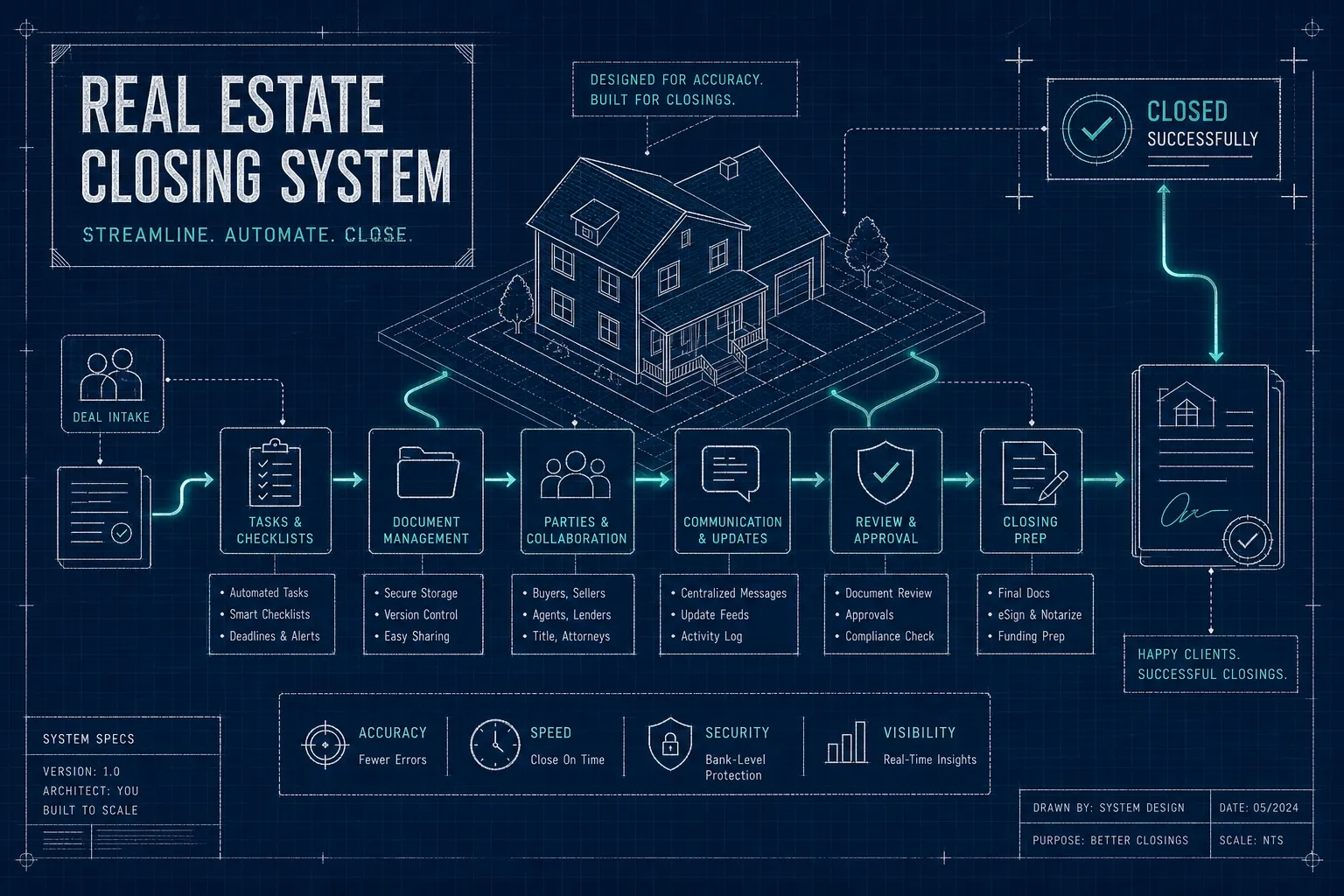
Once a deal goes under contract, the closing system shifts to transaction mode. The non-negotiables include a closing checklist that triggers automatically when a property moves to under contract and automated milestone reminders tied to contingency deadlines. Beyond those, you need a clear document ownership matrix so every party knows their responsibility and a mandatory pre-closing audit 48 hours before the final day. Tools like SkySlope and Dotloop automate most of this without manual oversight. The pre-closing audit step alone catches the mistakes that would otherwise become deal-killers at the worst possible moment. If you want a ready-made template for building those milestones and checkpoints, this real estate closing workflow guide walks through automated milestones and document ownership.
Daily Execution Habits That Make the Whole System Stick
The system only works if agents execute against it every single morning. A structured morning starts with reviewing pipeline numbers first, identifying the top three conversion priorities for the day, making the first outbound call before 9 AM, and blocking a two-hour prospecting window before noon. Agents who skip this structure spend the first hour of their day reacting to emails and text messages instead of moving deals forward. By 10 AM, the day has already been shaped by everyone else’s agenda instead of their own. For a repeatable prospecting schedule that sustains pipeline targets, see Real Estate Prospecting Consistency: The System That Works.
The hardest part of consistency isn’t knowledge. It’s knowing exactly what to do on a given morning without figuring it out from scratch every day. The PULSE Method addresses this directly. As the operational backbone of Power Unit Coaching’s training platform, it defines specific daily actions tied to an agent’s income goals rather than leaving them to self-direct each morning. It replaces guesswork with a pre-built execution engine. Not motivation, infrastructure. Agents who operate inside a defined system like this close more consistently because the system tells them what to do even when they don’t feel like deciding. If you want to learn how to build a consistent lead system that never dries up, read How to Build a Consistent Real Estate Lead System That Never Dries Up.
Track three KPIs every week without exception: number of new leads qualified, number of active pipeline deals, and number of appointments set. If the pipeline number is healthy but appointments are stalling, the follow-up cadence needs attention. If appointments are strong but closings are off, look at the scripts and transaction coordination process. These three metrics tell you exactly where the system is breaking down, which means you can fix the right thing instead of just working harder on everything. For more on turning inconsistent activity into steady production, see How to Get Consistent Real Estate Leads Without Relying on Luck.
The System Is the Answer to Closing More Real Estate Deals Consistently
Agents who close consistently aren’t luckier or more gifted. They’re more structured. The best system for closing more real estate deals consistently isn’t one tactic or one good script. It’s a connected set of decisions about how you qualify leads, follow up across channels, handle objections, coordinate transactions, and execute each morning. When all the pieces are in place, production becomes predictable. When one piece is missing, the whole thing wobbles.
Every element covered here, pipeline tracking, MAT qualification, the 8-to-12-touch follow-up cadence, closing scripts, transaction coordination, and daily execution habits, is exactly what the PULSE Method organizes into one operating framework. It’s all built inside Power Unit Coaching’s training platform for precisely this reason: because knowing what to do and having a system that actually makes you do it every day are two very different things.
The agents who stop improvising and start operating inside a repeatable closing system are the ones who stop wondering when the next deal is coming. They already know. The system tells them. If you’re ready to stop guessing and start closing on a schedule, download the free transaction coordination checklist and start building your system today.
