
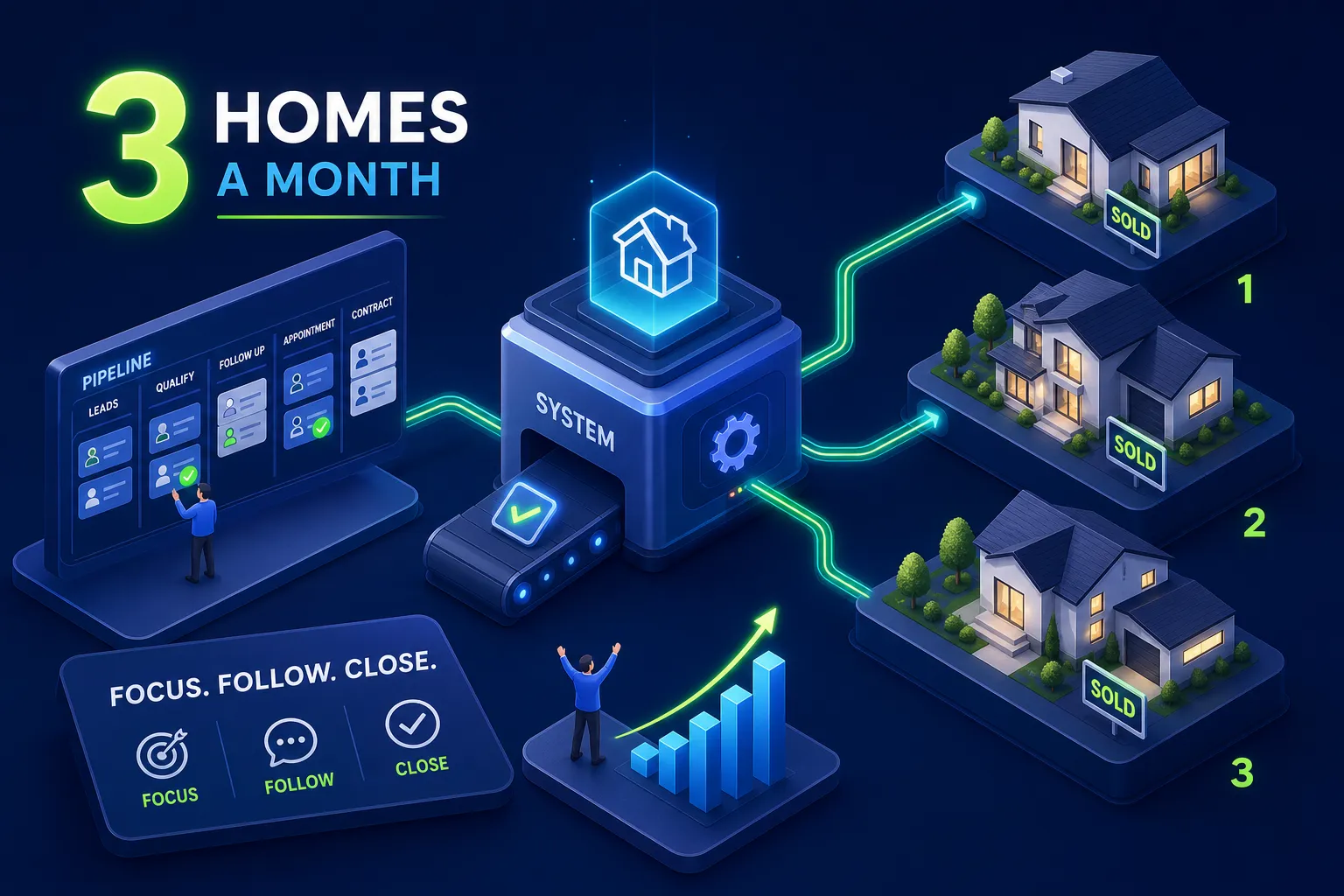
Most agents who struggle with inconsistent production aren’t lazy. They’re busy. They make calls, follow up on leads, go to showings, and somehow still end up with one closing one month and zero the next. If your goal is to close 3 homes a month, the problem isn’t effort, it’s that you’re running a random activity loop with no defined production target driving your daily decisions.
Closing zero deals one month and two the next isn’t a motivation problem. It’s a system problem. Motivation gets you out of bed; a production system tells you exactly what to do once you’re up. Without one, every week becomes a reaction to whatever feels urgent rather than a deliberate execution of what actually moves the needle.
Here’s the core reality: generating three closings per month is a math problem first and a process problem second. Both are entirely solvable. The PULSE Method, Power Unit Coaching’s proprietary production framework, was designed to reverse-engineer what consistent monthly closings require on a daily basis. This article walks through the full picture: lead volume, daily activity structure, pipeline management, follow-up cadences, and the KPIs that keep you on pace before it’s too late to course-correct.
The math behind how to close 3 homes a month
Before you change anything about your schedule or scripts, you need to understand the numbers. Most agents skip this step and jump straight to tactics. The math gives you a target; the tactics give you the tools to hit it.
How many contacts you actually need each month
To reliably close three homes per month, active residential agents need approximately 15 qualified appointments on the calendar each month. It’s important to separate two terms agents often conflate: contacts (calls, texts, and emails made) and qualified leads (contacts who express genuine interest and meet basic buyer or seller criteria).
Industry data suggests that at roughly 1.4% contact-to-appointment conversion, a benchmark associated with moderately experienced agents, you need approximately 70 contacts to book one appointment. At that rate, 15 appointments require around 1,050 contacts per month, or roughly 260 to 270 contacts per week. If you’re newer and operating closer to a 0.67% conversion rate, that contact volume climbs to approximately 2,200 per month to hit the same 15 appointments. Your own numbers may differ, but running this math against your actual conversion data is the only way to know how much outreach your pipeline truly requires. For a deeper look at industry conversion data, see resources on how much real estate leads convert.
There’s a second filter worth understanding: only about 35% of digital marketing contacts qualify as true leads. That means your raw outreach volume may need to run two to three times higher depending on your lead source mix. Agents who say they “don’t have enough leads” are often under-dialing rather than under-generating.
Understanding your appointment-to-close ratio
The next filter in the funnel is the appointment-to-contract rate. For active agents, an often-cited industry benchmark is approximately 60%, meaning 15 appointments should theoretically produce around 9 contracts. Real-world fall-through rates bring that number down, which is exactly why you need more contracts in the pipeline than your target closing number suggests.
There’s also a timing factor most agents ignore. The average contract-to-close timeline runs 43 to 45 days. The deals you’re closing this month were set in motion six to eight weeks ago. Consistent closings require a pipeline that is always being filled, not one that gets refilled after a dry stretch. If you wait until your numbers drop to start generating leads, you’ve already lost the following two months. For typical timelines and what to expect during closing, review guidance on how long it takes to close on a house.
Lead sources that reliably fill a 3-closing pipeline
Not every lead source delivers equal results when your target is to close 3 homes a month. Some sources convert fast; others require months of nurturing before they produce anything. Knowing the difference lets you allocate your time and budget where it actually counts.
The lead sources worth prioritizing
The data on close rates by source points in a consistent direction. Expired listings close at approximately 20.7%, the highest of any major prospecting category, according to REDX prospecting data. Referrals and sphere of influence contacts follow closely, converting at 14 to 20%, and they typically require far less follow-up time to reach a signed contract. Open house leads close at around 8.8%, while top-of-funnel internet leads from platforms like Google and Facebook average 2 to 2.5%.
Speed of response matters significantly across all these sources. Research from MIT and InsideSales.com found that responding to inbound leads within 60 seconds can improve conversion by up to 391% compared to a 30-minute response window. A referral that sits uncontacted for 24 hours is already cooling off regardless of how strong the source is. For additional context on lead-generation conversion benchmarks, see industry research on lead generation conversion rates.
Balancing your lead mix for steady monthly flow
Agents who rely on a single lead source are one slow month away from a pipeline collapse. A sustainable real estate pipeline for 3 closings a month draws from at least two active sources simultaneously. Most durable setups combine a warm relationship channel (sphere or referrals), a proactive outreach channel (expired listings or geographic farming), and some form of inbound activity (open houses or digital leads), though the exact mix should reflect your own conversion data, not just industry templates.
The key is knowing your personal conversion rate per source. If your open house conversion is running at 5% but your expired outreach is closing at 18%, those numbers tell you exactly where to spend your time. Build your lead mix around your own data and revisit it quarterly.
Structuring daily activities to hit your production target
Knowing the math is one thing. Executing against it every single day is where most agents lose ground. The gap between agents who close three homes per month and those who close one is rarely talent. It almost always comes down to structure.
A week built to help you close 3 homes a month
To book roughly 15 appointments per month (about four per week), you need approximately 260 to 270 contacts per week at a 1.4% conversion rate. That math makes a structured daily lead generation block essential, not optional. It’s not something you fit in around showings. It’s the engine of the whole system, and everything else gets scheduled around it.
Top producers structure their mornings in a consistent sequence: outreach block first, pipeline review second, appointment prep third. Lead generation before 11 AM is treated as protected time. Client-facing work fills the afternoons. Skip that morning block and your appointment numbers will show it two weeks later.
The PULSE Method: a daily execution framework for consistent production
Power Unit Coaching developed the PULSE Method as a structured daily operating system, not a vague to-do list. Most agents waste the first 45 minutes of their workday deciding what to work on. The PULSE Method eliminates that by defining the highest-impact activity for each part of the day, tied directly to an income goal rather than general best practices.
PULSEIntel PRO, Power Unit Coaching’s AI-powered planning tool, builds a personalized daily action plan each morning based on your specific income goal and current pipeline status. Rather than toggling between separate CRM, tracking, and scheduling tools, everything feeds into a single daily output. Agents working from a structured execution plan stop guessing what to prioritize, the system makes that decision for them.
CRM workflows and follow-up scripts that keep deals moving
A full pipeline means nothing if deals are stalling inside it. Pipeline fall-through is one of the most common reasons agents miss their closing target even when they have adequate lead volume. The fix is a CRM workflow that moves deals forward systematically and a follow-up cadence that outlasts the average agent’s patience.
Stage-based workflows that prevent stagnation
Stage-duration alerts are the first thing any agent should configure in their CRM. When a lead sits in a pipeline stage longer than the typical time-to-close for that stage, it’s a signal to intervene, not wait and hope. High-volume agents use auto-follow-up triggers that fire based on deal behavior rather than manual calendar reminders, so nothing slips through during a busy week. Pair those triggers with an AI-powered follow-up system to ensure round-the-clock persistence for time-sensitive inbound leads.
Leads also need to be segmented by source because each source requires a different follow-up rhythm. A sphere referral who already knows and trusts you needs a different cadence than a cold expired listing contact who just heard your name for the first time. Treating all leads identically is one of the most common pipeline mistakes agents make.
Scripts that move leads from contact to contract
The most effective scripts are milestone-triggered, not generic. Your first-contact script should be completely different from a no-response follow-up at day five or a re-engagement attempt at day 30. Each touch has a specific purpose and should match the prospect’s stage in their decision-making process.
The biggest fall-through point in most pipelines is post-appointment silence. Most agents send two follow-up messages, get no response, and quietly remove the lead from active pursuit. High-volume agents follow a structured 8 to 12 touch sequence before a lead leaves active pipeline status. That persistence gap is what separates a 1% conversion rate from a 3% one. Power Unit Coaching’s platform includes AI role-play simulations that let agents practice objection responses in a low-stakes environment before live calls, the goal being that reps build comfort with the scripts before they need them on the phone.
The weekly KPIs that tell you whether you’re on pace
Closings are a lagging indicator. By the time you see a problem in your closing count, it’s too late to fix that month. Agents who consistently close 3 homes a month track leading indicators weekly and course-correct before the pipeline runs dry.
The numbers worth tracking every single week
Four metrics tell the full story of your pipeline health: contacts made, appointments booked, contracts signed, and pipeline stage distribution. These aren’t vanity numbers; they’re cause-and-effect relationships. If your contact volume drops in week one, your appointments drop in week two, and your closings drop in weeks six through eight. The signal always comes early if you’re watching the right data.
Example targets based on standard conversion benchmarks: 70 or more contacts per day, three to four new appointments per week, and one contract per week on average across a four-week cycle. These should be calibrated to your own conversion rates, agents running above or below the 1.4% benchmark will need to adjust the contact volume up or down accordingly. The structure matters more than the exact number; what you’re building is a set of leading indicators that telegraph problems six to eight weeks before they show up as a missed closing.
What to do when your numbers drift off target
When the numbers slip, the first two things to check are lead volume and appointment conversion. They aren’t the only things that can go wrong, deal fall-throughs, contract timing delays, and underwriting hiccups all play a role, but they’re the most actionable levers for triage. A lead volume drop requires fixing the top of the funnel by adding outreach hours or new sources. An appointment conversion drop requires fixing the script or the follow-up cadence. Tracking weekly tells you which problem you’re actually solving rather than throwing effort at both simultaneously.
The compounding effect here is significant. Agents who track weekly and adjust within the same week protect their closing totals for the month. Agents who wait for a monthly review have already lost four to six weeks of pipeline momentum. At a 43 to 45 day contract-to-close timeline, that’s two months of closings already gone before they even realized there was a problem.
Build the system, then work the system
If your objective is to close 3 homes a month, the path forward is a production system, not more motivation. That means defined math based on your actual conversion rates, a daily structure that protects your lead generation block, active pipeline management that catches stalls early, and weekly KPI tracking that gives you enough lead time to fix problems before they become missing closings.
Know your contact volume requirements. Build a mix of at least two active lead sources. Execute a daily plan that treats prospecting as the first priority. Keep your CRM stages moving with automated workflows and persistent follow-up. Review the four core pipeline metrics every week. Run that system with consistency and your results stop being a surprise.
For agents who want a daily execution engine rather than another course to sit through, Power Unit Coaching’s PULSE Method and PULSEIntel PRO are built for exactly this. Every morning, you get a personalized action plan tied directly to your income goal. If consistent monthly closings are the target, explore Power Unit Coaching’s platform and see what a real production operating system looks like in practice.
